
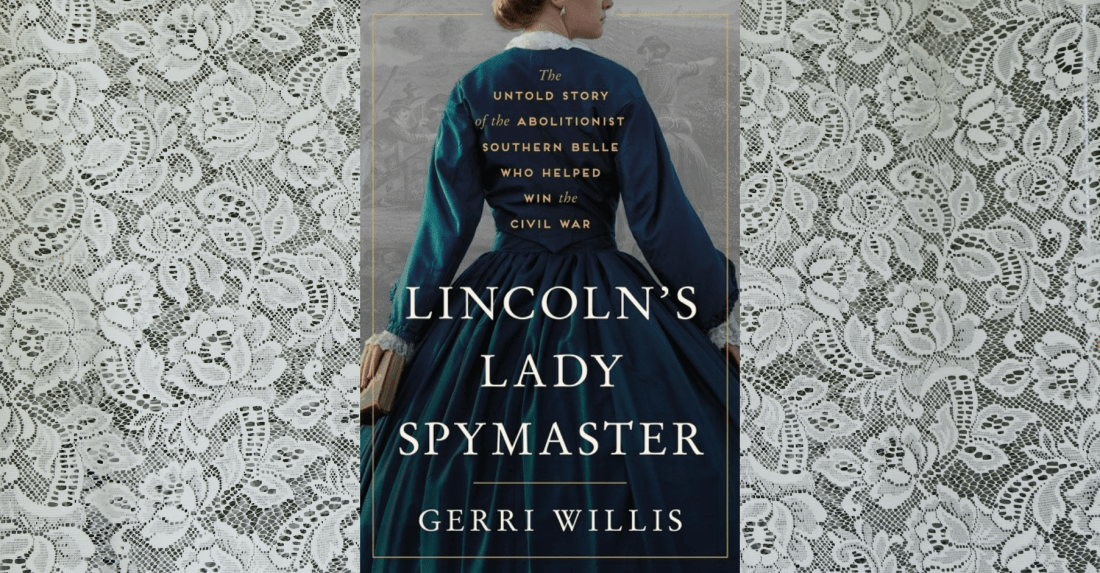
In an academic article in 1976, Pulitzer Prize-winning historian Laurel Thatcher Ulrich wrote, “Well-behaved women seldom make history.” Southern Belle Elizabeth Van Lew, the eponymous spymaster in Gerri Willis’ Lincoln’s Lady Spymaster, certainly fit this bill, making history as one of the “Big Five” female spies of the American Civil War. In an engrossing and thoroughly researched narrative that practically writes itself, Willis chronicles Van Lew’s evolution from Union sympathizer to Union spy to Union spymaster and ringleader. Van Lew had “a contrary nature and [a] gift for organization,” Willis writes, both characteristics that made her “the perfect spymaster.”
Van Lew was not your stereotypical Belle. The granddaughter of a Revolutionary War hero, she was educated in Philadelphia and was a staunch abolitionist. But she was raised in one of the finest mansions atop Church Hill, an elite address in Richmond, Virginia, where she enjoyed a position at the pinnacle of society.
As I read Willis’ biography, it became clear how much Van Lew and her hometown of Richmond had in common. Both existed in a sort of in-between space, not quite North and yet not quite South either. As the nineteenth century wore on, after all, Richmond “more and more resembled the Industrial North rather than the South.” And yet, when the Civil War broke out in 1861, it was the political capital of the Confederacy.
Van Lew wasted no time in using her status as a genteel Southern lady to obscure her pro-Union escapades, despite the danger to herself and to her family and friends. We must be “wise as serpents — and harmless as doves,” she wrote in her diary in 1862.
Over the course of her career, she gave aid to Union officers and soldiers languishing in Richmond’s prisons, even smuggling many of them out of prison and across enemy lines. She organized and trained a diverse group of sympathizers, including servants, freedmen, merchants, and even officials in President Jefferson Davis’ fledgling Rebel government.
Her spycraft included sending and receiving secret messages in books lent to prisoners, disguising herself as a washerwoman, secreting documents in hiding places around her home, concealing Unionists in a secret room on the third floor of her house, using invisible ink and a cipher to encode messages, sending messages in a hollowed-out egg in a basket of eggs or in the heels of servants’ shoes, and grave-robbing under the cover of darkness.
Her ring was initially focused on aiding prisoners of war but morphed into a focus on the Confederate war machine, detailing Richmond’s defenses and Rebel troop movements.
In the war’s later years, her activities helped usher in an age of more formal, more organized military intelligence. “If Union officials had been expecting small kernels of intel from a genteel Southern lady,” Willis writes, “what they got instead were detailed reports with actionable information from a woman weary… of surreptitiously fighting Rebels.” Van Lew was an exceptionally good spy, ingenious and resourceful.
Willis devotes a chapter to the 1864 Union prisoner escape from Libby Prison, the Civil War’s largest and most storied prison break, which was supported by Van Lew. She also details the spymaster’s involvement in what became known as the Dahlgren Affair and in General Ulysses S. Grant’s final and ultimately war-ending assault on Richmond.
I especially enjoyed the author’s willingness to explore further afield, to add needed context to Van Lew’s activities. None of us live and work in a vacuum, after all. In these pages we spend time with Confederate spy Rose Greenhow, President Abraham Lincoln, Lincoln’s assassin John Wilkes Booth, Union Army Colonel Ulric Dahlgren, the modest and occasionally alcoholic General Grant, and members of the nascent American military intelligence operation.
In a speech in 1864 Lincoln thanked the women of America for their extraordinary efforts in support of the Union during the Civil War. I can only hope he had Van Lew top of mind.

NONFICTION
Lincoln’s Lady Spymaster:
The Untold Story of the Abolitionist Southern Belle Who Helped Win the Civil War
By Gerri Willis
HarperCollins Publishers
Published June 3, 2025


